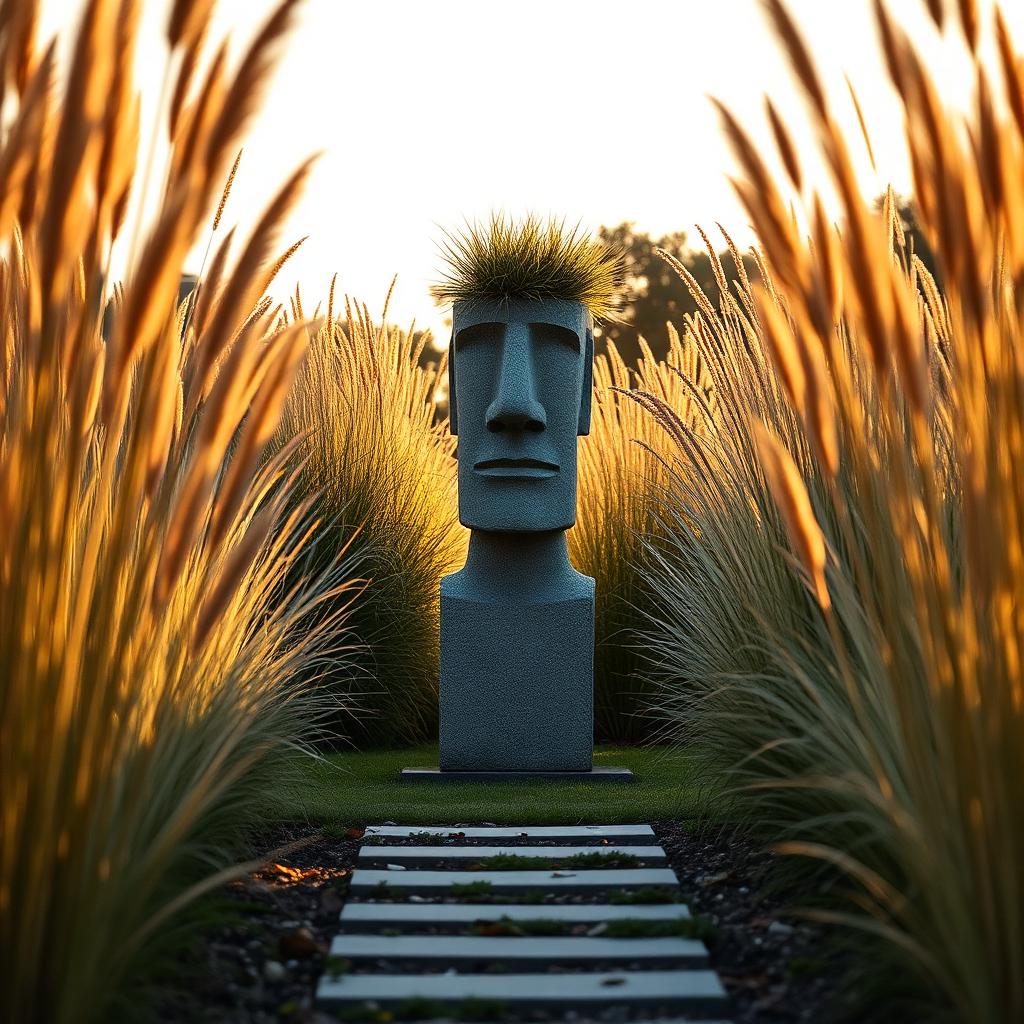
A Moai stone head, a monolithic tapered tower, a hand-carved Buddha bust or a lattice orb the size of a small car — sculptural planters are visual events. Used well they lift a garden from pleasant to memorable. Used badly they clutter and fight everything else in the space.
The single-hero rule (again)
One statement piece per garden view. Not per garden — per view. A front garden and a rear terrace can each have their own hero. A single terrace cannot have two.
Framing: end-of-sightline placement
Sculptural pieces earn their keep at the end of a sightline — the visual full stop of a view. Test candidates:
- The top of a set of steps, seen as you enter the garden
- The pivot of an L-shaped path
- The head of an outdoor dining table
- The centre of a lawn viewed from the main window of the house
If you can stand at the entrance of your garden and draw an imaginary arrow, the statement piece goes at the tip of that arrow.
Scale up, not down
Statement pieces almost always want to be larger than instinct suggests. A 60cm Buddha head that looks huge in the showroom vanishes in a 15m garden. Rule of thumb:
- Small courtyard (up to 6m²): 60–80cm piece
- Standard rear garden (up to 40m²): 90–120cm
- Large garden (40m²+): 120cm and up, without hesitation
Give it air
A statement piece needs empty ground around it. A minimum of 1m clear on all sides; ideally more. Crowded up against a fence or crammed between other pots, it looks apologetic.
The base
Under-plant with something quiet and low — a fringe of ornamental grass, a single fern, a mat of creeping thyme. The purpose is to soften the transition to the ground, not to compete for attention.
Materials and finish
Choose a piece that reads as one material continuous with your garden's palette, not one that fights it.
- Weathered stone works with any traditional garden
- Black or graphite fibreglass suits modern architectural gardens
- Terracotta and warm ochres pair with Mediterranean planting
- Verdigris or oxidised bronze finishes work with mature planting and old walls
Avoid mixing statement piece finishes across the same garden. One statement piece in one register, held.
Lighting is half the effect
A statement piece unlit at night is 40% of its potential. A statement piece uplit from ground level, casting long shadows onto a wall behind, is unforgettable.
The lighting kit
- One warm-white uplight (2700K, 3W) at the front-base of the piece, angled up
- A second uplight to one side, closer to the ground, throwing a longer shadow
- Nothing else in the immediate area — no path lights, no fairy lights, no accent uplights on nearby shrubs
Statement pieces earn dedicated, exclusive lighting.
The five most common mistakes
- Buying too small — see scale rule above
- Placing near an entrance — the piece should be discovered from a distance, not confronted at the door
- Surrounding with plants — the piece needs air
- Adding a second statement piece in the same view
- Skipping the lighting — half the impact is lost
When to break the rules
Formal gardens with strong axial symmetry can carry a matched pair — one on each side of a central path, mirrored. That is the only situation where two statement pieces belong in the same view, and both must be truly identical.
Otherwise: one hero, one view, one lighting rig. Let it work.