Small spaces reward restraint. Almost every failed courtyard or balcony has too many things in it — too many pot shapes, too many plant types, too many small decorative objects — and the eye reads it as clutter, no matter how carefully each piece was chosen. The fix is subtractive, not additive.
The single-hero rule
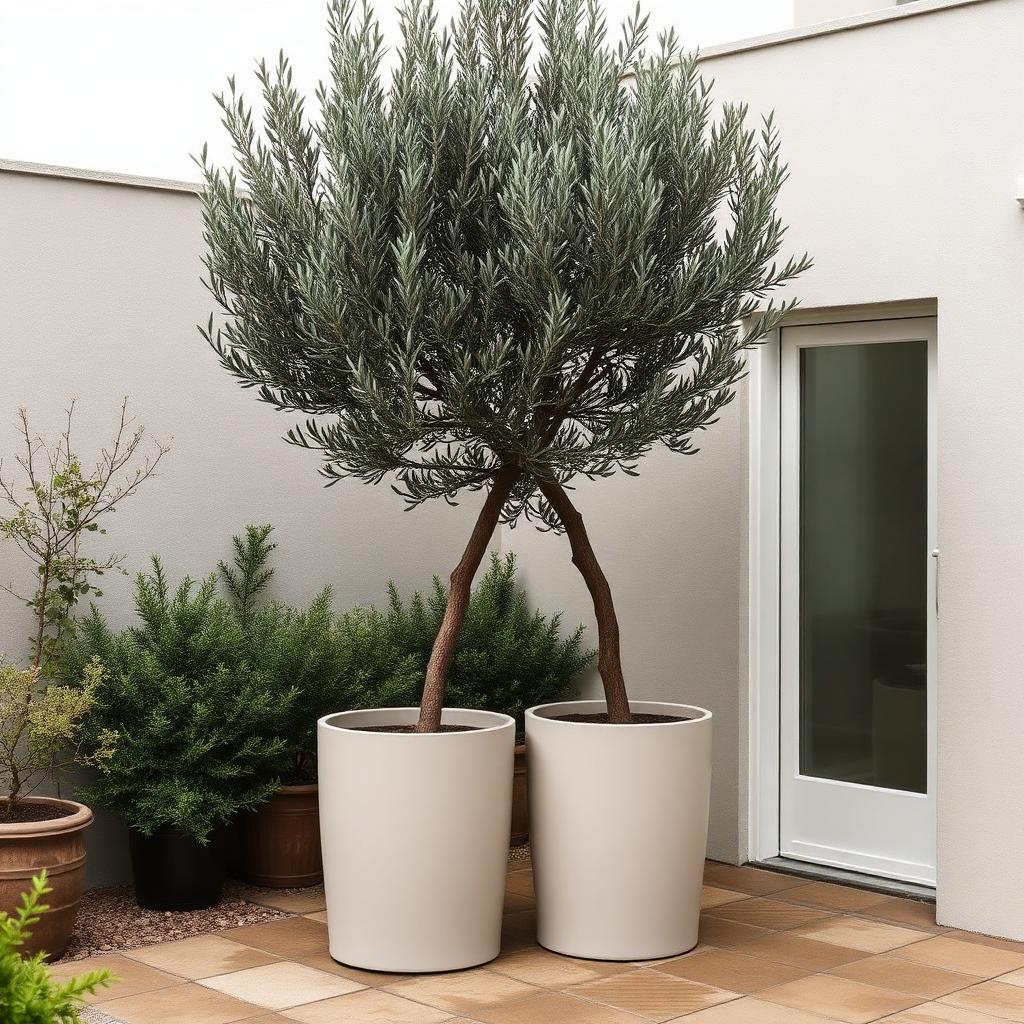
One tall statement pot beats five small ones, every time. In a 4m² balcony a single 90cm cylinder with an olive is more powerful than eight 30cm pots crammed along the railing.
Verticality borrows space from above
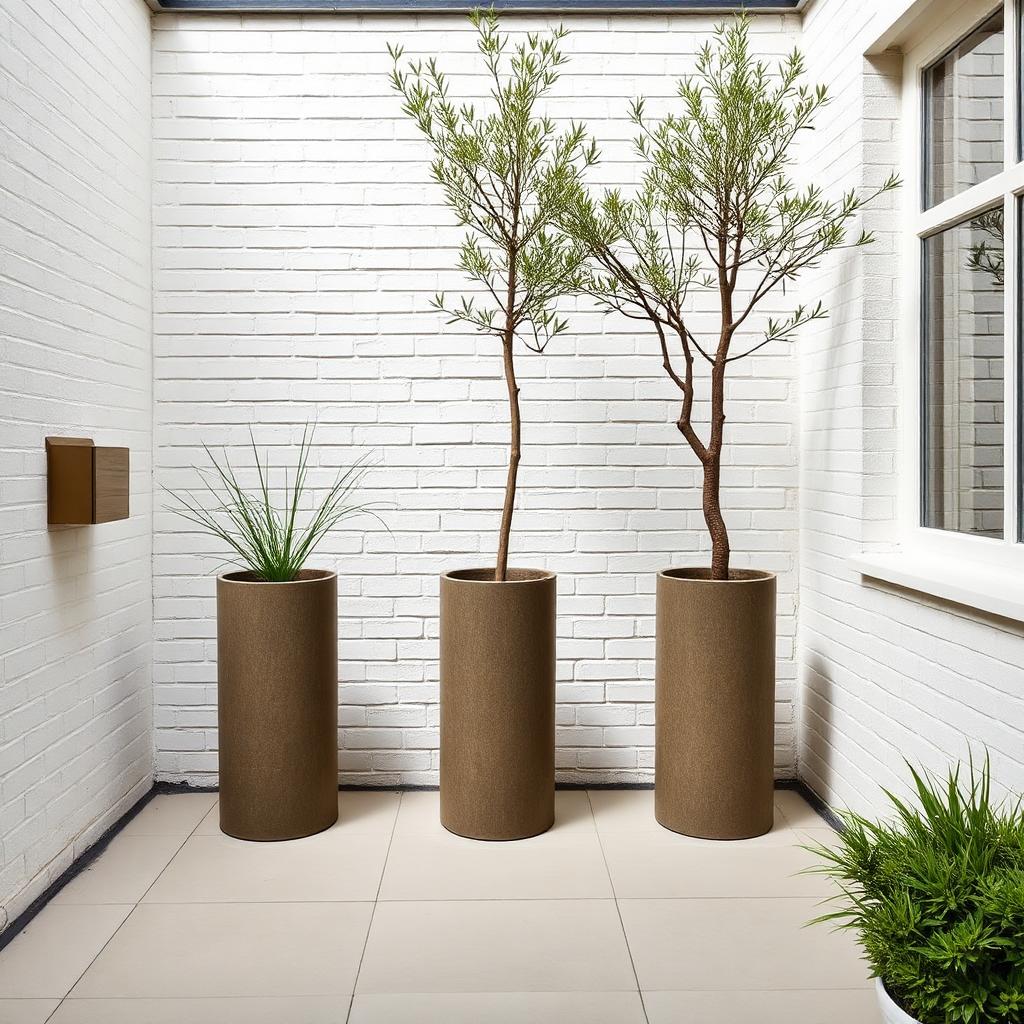
Small gardens are always short of floor area, but they have plenty of vertical air. Tower silhouettes — 80cm to 120cm tall cylinders and slim tapers — use that air.
- Two tall towers flanking a doorway make a 2m-wide return feel processional
- A single 120cm tower with a slender tree at the pivot of an L-shaped courtyard draws the eye upward and away from the walls
- Wall-mounted planters at 1.5m and 2m heights layer green vertically without eating floor
Repetition beats variety
Three identical 45cm cylinders along a boundary reads more considered than three different pots in three different finishes. The eye locks onto the repeat and reads calm; visual noise drops away.
The magic of the trio
Groupings of three — same shape, same finish, three heights (say 40 / 60 / 80cm) — are the workhorse move for small spaces. They:
- Build a rhythm the eye follows
- Fill a corner without cluttering it
- Read as a single composition, not three separate pots
Negative space is a design element
Leave floor showing. A small terrace with 60% of its floor visible feels twice as large as one with the same pots pushed edge-to-edge. Empty paving isn't wasted — it's the counterpoint that makes the planted areas legible.
Colour discipline
Small spaces cannot absorb multiple planter colours. Pick one — usually the tone of the walls or paving — and hold it across every pot. Terracotta on limestone; charcoal on London stock brick; bone-white on painted render. The plants provide the colour; the pots provide continuity.
The five moves that fix most small spaces
- Remove half. Start by taking half your existing pots out. Live with the reduced set for two weeks before adding anything back.
- Match finishes. If you have three planter finishes, replace two of them so all pots read as a set.
- Introduce one tall. If everything is 30–40cm, add one 90cm+ pot as the anchor.
- Push to the edges. Small spaces feel bigger when pots hug the perimeter, freeing the central floor.
- Group in odd numbers. Threes and fives, never fours.
Balconies specifically
Balconies have three constraints small courtyards don't: weight limits, wind exposure and drip drainage.
- Check your building's load rating. A saturated 60cm planter with tree can weigh 100kg+.
- Fibreglass is 4–5× lighter than concrete or terracotta at the same size — usually the correct choice on a balcony.
- Every pot needs a saucer AND drainage. Water shed off a balcony onto a neighbour's terrace is a fast route to a complaint.
- Bolt planters to the balcony structure if you're above the third floor. Wind loads are real.
Roof terraces
Same principles as balconies, plus:
- Use screening — trellis panels or slatted timber — to break the wind for tender plants
- Keep pots away from the parapet edge; wind eddies pull leaves off in gusts
- Consider automated drip irrigation; roof terraces dry out fast in summer
Side returns and passageways
The narrow strip beside a house. Rule: keep it linear.
- Wall-mounted planters on one side only (never both — clips shoulders)
- Ground pots run in a single line, matching sizes
- Uplights at the base of each pot turn the walk into a moment at night
Small doesn't have to mean modest. Restraint scales.